
| Common Needlewort |

|
 |

|


 |
 ative ative |
 |
 |
 |
Photo: |
Botanical name: Ifloga spicata Family: Asteraceae (Sunflower family)
Synonyms: Chrysocoma spicata, Trichogyne spicata
Synonyms: Chrysocoma spicata, Trichogyne spicata
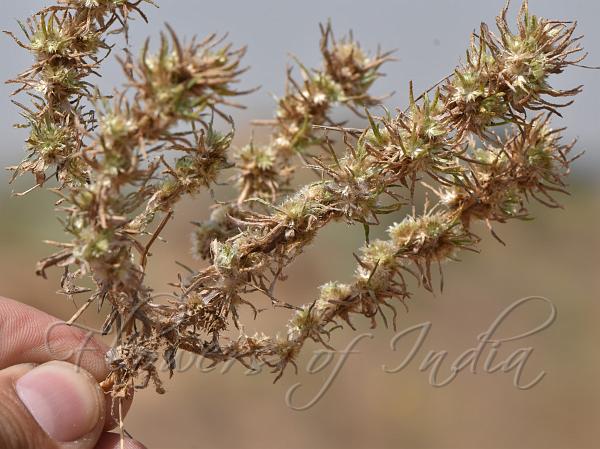
Common Needlewort is an annual herb, 5-12 cm high,
often branched from the base, stem and branches forming a dense
globular to cylindric inflorescence from near the base or in the upper
part. Leaves are woolly to silky-woolly, becoming hairless beneath,
often with adhering sand-grains, 6-20 mm long, about 1.2 mm wide, with
wider sheathlike base, the margins more or less involute. Flower-heads
arise in groups, congested on small lateral branches, overtopped by the
leaves. Disc florets are numerous, bisexual, narrowly tubular with
indistinct teeth. Involucre is 3-4 mm long; phyllaries, hyaline,
brownish to stramineous, apiculate, the inner with a thickened
yellowish mid-rib, median and inner fertile and subtending a single
female florets each. Cypselas brown, 0.5-0.6 mm long, obovoid; pappus
(only in the bisexual florets) of easily falling bristles, plumose in
the upper part, about 1.5 mm long. Common Needlewort is found in SE
Spain, Macaronesia to India and Arabian Peninsula, including Western
Himalaya and Western Ghats.
Flowering: February-September.
| Identification credit: Nidhan Singh | Photographed in Siwani, Haryana. |
• Is this flower misidentified? If yes,